
For Educators: Teaching Units & Lesson Plans:
Language
Lesson Plan 2: Nonverbal Communication
OBJECTIVES
Students will:
- identify several challenges to communication
- list several kinds of nonverbal communication
- draw conclusions from a narrative passage
MATERIALS
| IMAGES | |
| OBJECT | |
| TEACHER READING |
Gestures and Symbols (PDF) |
| STUDENT READING |
Group 1 – Language of the Robe (PDF) Group 2 – Language of Gestures (PDF) Group 3 – Language of Symbols (PDF) |
| SUPPLIES |
Current U.S. map with latitudinal and longitudinal coordinates marked. Small copybooks or paper for each student to be used throughout the unit as a journal. |
OPENING
Begin class through a series of gestures to demonstrate nonverbal communication (pointing to tell students to sit down, finger to lips to be quiet, etc.).
Opening question: What if an interpreter was not available to Lewis and Clark on the trip? How would they have been able to communicate with the Indians?
PROCEDURE
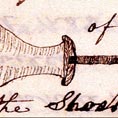 Explain to the students that they will be reading about ways Meriwether Lewis tried to communicate with the Shoshone Indians. Look on the map of Indian cultures and ask students to identify historic Shoshone lands. Lewis and Clark met up with the Lemhi Shoshone on the Continental Divide between present-day Dillon, Montana, and Salmon, Idaho. The events they will read about took place south of Salmon.
- Divide students into five groups. Each group will receive a different reading that explains the challenges of nonverbal communication through gestures and symbols. The first part of the reading is the same for each group, the second part highlights a specific way that either Lewis or the Shoshone Indians attempted to communicate. Students should answer the following questions based on their reading:
- Who is sending the message, who is receiving? (Lewis or the Shoshone)
- What is the message that people are trying to communicate? (peace, friendship, don't be afraid, etc.)
- What method are they using to communicate the message?
- What reaction did the receivers have?
- In your opinion, did the method of communication work?
- How would you describe this method of communication?
Teacher may want to use the first paragraph describing Lewis's first attempt at communication as an example for the procedure.
- After students have had time to complete the exercise, have each group report to the entire class providing a summary or their reading. Show students the images that relate to their particular reading. Language of the Robe— 3 images, Language of the Pipe— 1 image
CLOSING
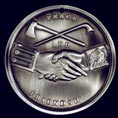 Show students the peace medal image or pass around a reproduction peace medal. Without telling them what the object is, have them look at it and describe the designs on it. What does it communicate? They will recognize the gesture of shaking hands. Explain that Lewis and Clark gave these objects to the various Indian leaders they met on their expedition. Based on what they just learned regarding gestures, ask them if they think this was an effective symbol to use on a peace medal.
Students should design their own peace medal featuring designs that they think would convey peace and friendship to cultures that may not have the same greeting or gesture as their culture. They should write a brief paragraph explaining their design.
SUGGESTED FORMATIVE ASSESSMENT
Collect student peace-medal designs and written explanations.
