
For Educators: Teaching Units & Lesson Plans:
Preparing for the Trip
Lesson Plan 3: Who's Who in Philadelphia
OBJECTIVES
Students will:
- gather and analyze information from primary documents and short biographies to infer the role and importance of each person in Lewis's training for his expedition
MATERIALS
| STUDENT READINGS |
Jefferson to Benjamin Smith Barton (PDF) Jefferson to Caspar Wistar (PDF) Jefferson to Benjamin Rush (PDF) |
| IMAGES | |
| WEB SITE LINKS |
Monticello Web Site Biographies of Ellicott, Barton, Wister, Rush, and Patterson, photocopied or available online: Lifelong Learning, The Lewis and Clark Rediscovery Project |
| ACTIVITY SHEETS |
Attribute Web Graphic Organizer (PDF) Document Analysis Guide (PDF) |
| SUPPLIES |
Chart paper for recording student responses |
OPENING
Besides Peale's Museum, the other center of learning was the American Philosophical Society, an organization of members dedicated to research and accumulation of knowledge about the scientific world. The society encouraged research on topics like ship pumps, stoves, peach blight, dyes, and street lighting as well as more abstract subjects. Lewis spent time in May 1803 absorbing the advice of the learned men who frequented the museum and the philosophical society. On their recommendations, he assembled a reference library of books to take on the expedition. The eclectic titles encompassed geography, mathematics, astronomy, mineralogy, botany, and zoology.
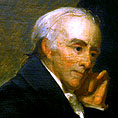 Display the portraits of Rush, Patterson, Ellicott, Barton, and Peale. Tell students that these people lived in or near Philadelphia. Explain the objective to the class: to read letters from Thomas Jefferson and brief biographies of five people who were experts in their fields who met with Lewis before his journey, to gather information and analyze their role and purpose in shaping his mission.
PROCEDURE
- Divide the class into cooperative groups of four to five per group with a recorder and reporter in each group.
- Distribute to each group one of Jefferson's letters and the biography of that person and a copy of the activity sheet, a graphic organizer (attribute web). There is no letter for Peale.
- Students will read letters and biographies and record information on an attribute web about their person, being sure to include their area of expertise or field of study. Students may find the document-analysis guide helpful in directing their analysis of the letters. The caption with the image also provides information.
- Reporters from each group will share information about their person with the whole class.
- Teacher will record notes on large chart-paper attribute web for each person.
CLOSING
Close with a discussion:
Using the information from the letters and the biographies, what do you think Lewis learned from each person that helped him prepare for his expedition? Be sure to cite evidence from the letters. As students respond, teacher will complete a chart that lists the name of each person and the role he played.
Optional: Create a bulletin board display of each person's portrait. (None is available for Wistar; use the mastodon fossil instead.) Label each with the person's name and their expertise (Students could help guess which person is which.)
SUGGESTED FORMATIVE ASSESSMENT
Journal writing: Write a journal entry from Lewis's point of view. Summarize what you learned from each person you met with in Philadelphia, and explain how that knowledge might help you on your expedition.
EXTENSION
Lewis met with Andrew Ellicott in Lancaster, Pennsylvania, which was approximately sixty miles west of Philadelphia. Use a map to locate Lancaster, and use the scale to estimate the distance. Teach the significance of the Lancaster Turnpike as the first paved road to be used for transportation at the time. Include the origin of the word turnpike and a lesson on the Conestoga Wagon, commonly used by Lancaster County farmers for transportation of goods to Philadelphia markets at the time. See U.S. Department of Transportation website for useful information and pictures: www.fhwa.dot.gov/rakeman/1795.htm
